
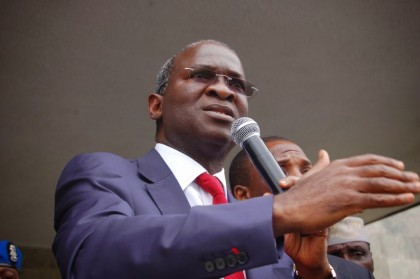
Minister of Power, Works and Housing, Mr. Babatunde Fashola SAN, Tuesday, in Abuja, highlighted the goals of the 2016 Budget expressing confidence that the implementation modalities adopted by the present administration would lead the economy out of the current recession.
Fashola,
who spoke, alongside eight of his colleagues in the Federal Executive
Council, at the Town Hall Meeting/Policy Dialogue for Good Governance
organized by the Alumni Association of the National Institute for Policy
and Strategic Studies in collaboration with the Federal Ministry of
Information and Culture, said by reordering the expenditure focus of the
budget, government has set the economy on the path of growth and
recovery.
The
Minister, who described the allocation of 30 per cent of the N6
Trillion Budget to Capital Expenditure, as historic in the annals of
budgeting in the country, said by doing so, government has ensured that
more of the budget would impact on the larger society as against the
previous practice where those in government, who constitute less than
three per cent of the population, got the bulk share.
Highlighting
the impact of the Budget across board, Fashola, who disclosed that N102
Billion was released to his Ministry out of the N300 Billion already
released by the Federal Government, said as at July this year, N70
Billion had been paid out to contractors, project managers and
consultants designing roads and bridges adding that with the payment,
the various contractors have returned to site.
The
payments, the Minister said, were being made on the condition,
commitment and understanding that the contractors, who left site as a
result of non-payment of their fees for over two years, would begin to
reemploy back workers that they had laid off adding that adherence to
this has led to the recall of thousands of workers previously laid off
by the contractors.
Insisting
that it is the only way out of recession, Fashola declared, “We begin
to spend on the productive sector so that at every construction site not
only do we see plants and equipment and machinery back and working, we
see demand for diesel and petrol, water tankers begin to roll, sale of
sand and gravel begin to happen , food vendors move back to those sites
to supply food and water to those who are working and so on and so forth
where activity begins. That is the way, there is no other way”.
“That
is stimulus spending that happened in America, that is the Marshal Plan
that happened in Europe; that was the Roosevelt Plan after the Great
Depression. So we are not doing anything unusual. The only difference
now is that we are working with leaner resources and seeking to do more
with less”, he said.
He
listed the road projects where contractors have returned to site as a
result of the payments, to include the Kano-Katsina Road, Kano-Maiduguri
Road, the Ilorin-Jebba Road, the Loko-Oweto Road, the Lagos-Ibadan
Expressway and the Port Harcourt –Enugu Road among a number of others.
In
the Power Sector, Fashola said with the money available, the Ministry
was currently working to complete the 215MW Kaduna Power Plant, the
transmission line for the Gurara 40MW plant, the Kashimbilla Plant and
some of the other power projects, adding that it was also remobilizing
contractors back to the transmission sites.
The
Minister explained that it was necessary to revitalize the transmission
lines, most of which had stopped for over two years as a result of
non-payment of contractors, in order to be able to evacuate power being
generated pointing out that some of the contractors couldn’t clear some
of the equipment they imported.
“Some
have been trapped at the ports for decades”, he further explained
adding that government was now trying to clear all those parts for the
contractors some of who, according to him, are owing clearing agents in
the excess of about N3Billion. He, however, said the Ministry was
working with the Office of the Vice President to sort out all the issues
“and also ensure that monies when ultimately spent are spent for
value”.
Fashola
said in spite of the setbacks, progress was being made in such places
as Irrua in Edo State where transmission work is currently going on,
Okada Transmission project, also in Edo, where work has been completed
adding that although problem was encountered in Itu local government
last month where work stopped on the Itu-Calabar Transmission line over
some communities issues, the project was back on track as the issues had
been resolved.
Recalling
his recent visit to Maiduguri, the Minister disclosed that the
contractor handling the Damboa Transmission Power in Borno State and who
had left site because of the violence and insecurity there, was back on
track and said he would finish the project by the end of this year.
Expressing
confidence in the implementation modalities of the administration,
Fashola declared, “When all of these come together, clearly we will
begin to see life getting back to normal”, adding, however, there was
need to stay focused.
He
told the audience, “It is a tough time, we are mindful. And the purpose
of our coming here, if I may say so on behalf of our colleagues, is
also to see whether there are things that we are missing and to listen
to them, take them back in and see what we can do to improve them”.
On
how the nation was drawn into economic recession, Fashola explained
that in spite of the huge resources available to the previous
administration, contractors handling various projects across the country
were not paid for over two years resulting in their abandoning the
sites and sacking their workers who as a result lost their means of
livelihood.
“The
story we met was that contractors, whether in Works, Power or Housing,
saying that over the last two to three years, they had not been paid. So
that was the time the seed for this recession was sown; money
increasingly leaving the economy, leaving the hands of people who work
on day to day basis”.
“The
result was that workers were being laid off gradually, progressively
and systematically and as workers lost their jobs, money stopped moving
because they stopped buying, they lack purchasing power and those who
were selling were also losing their livelihood. That is the story to
where we are today”, he said.
The
Minister, who also explained that out of the N300 Billion already
released by the Federal Government since the Budget was signed, his
Ministry
received N102 billion, added “It has been described as a lion share of
the N300Billion but it is a lion share against our realities and the
realities are that we inherited 206 roads under construction and the
liabilities for those roads were in the region of N2.1Trillion”,
pointing out that government has paid about N600 to N700 Billion of the
amount.
Recommending
fiscal spending as a way out of the recession, the Minister, who
described the 2016 Budget size as ambitious, added that an increased
budgetary size would enable the administration fund the various capital
projects that would impact on the livelihood of the population.
He
explained further, “From an average N4 Trillion, which is the average
budgetary size of this country for over half a decade when we were
earning $100 a barrel of oil per day, we are going now from there to
N6Trillion when we are earning significantly less than that. It is
ambitious”.
“But
what has also changed, for those who say they haven’t seen change, let
me dimension that, what has changed is that from spending 10 to 15 per
cent of our budget on capital and spending more than 80 per cent on
recurrent, this government has now committed to spending 30 per cent of
N6 Trillion on capital and 70 per cent on recurrent”, he said.
According
to Fashola, “In government circles, the people in government usually
constitute barely 1 or 2 per cent of the entire population. So a
government that continuously chose to spend 90 per cent of its earnings
on one or two per cent of the population leaving 10 per cent for all the
contractors, for all the roads, for all the suppliers, clearly was on
the path to where we are today”.
Advocating
public enlightenment on the annual budget, Fashola said there was need
for all Nigerians to become more familiar with how the budget process
works pointing out that many Nigerians still think that any time that
budget was said to have been passed it was cash at hand.
“It
is an approval to spend a certain agreed sum on identified areas”, he
explained adding that it was important for members of the public to
understand that when budget has been approved for a Ministry or a
Department, it wasn’t cash.
Describing
the Town Hall meeting as instituted by the administration as the reward
for sticking to democracy, Fashola, who said it was the first time, in
recent times that an administration was coming out to give account of
its stewardship when no election was in sight, declared, “Government is
out here saying this is what we are doing, this is what we want to do,
this is the direction we are heading so that we have some measure of
accountability”.

No comments:
Post a Comment